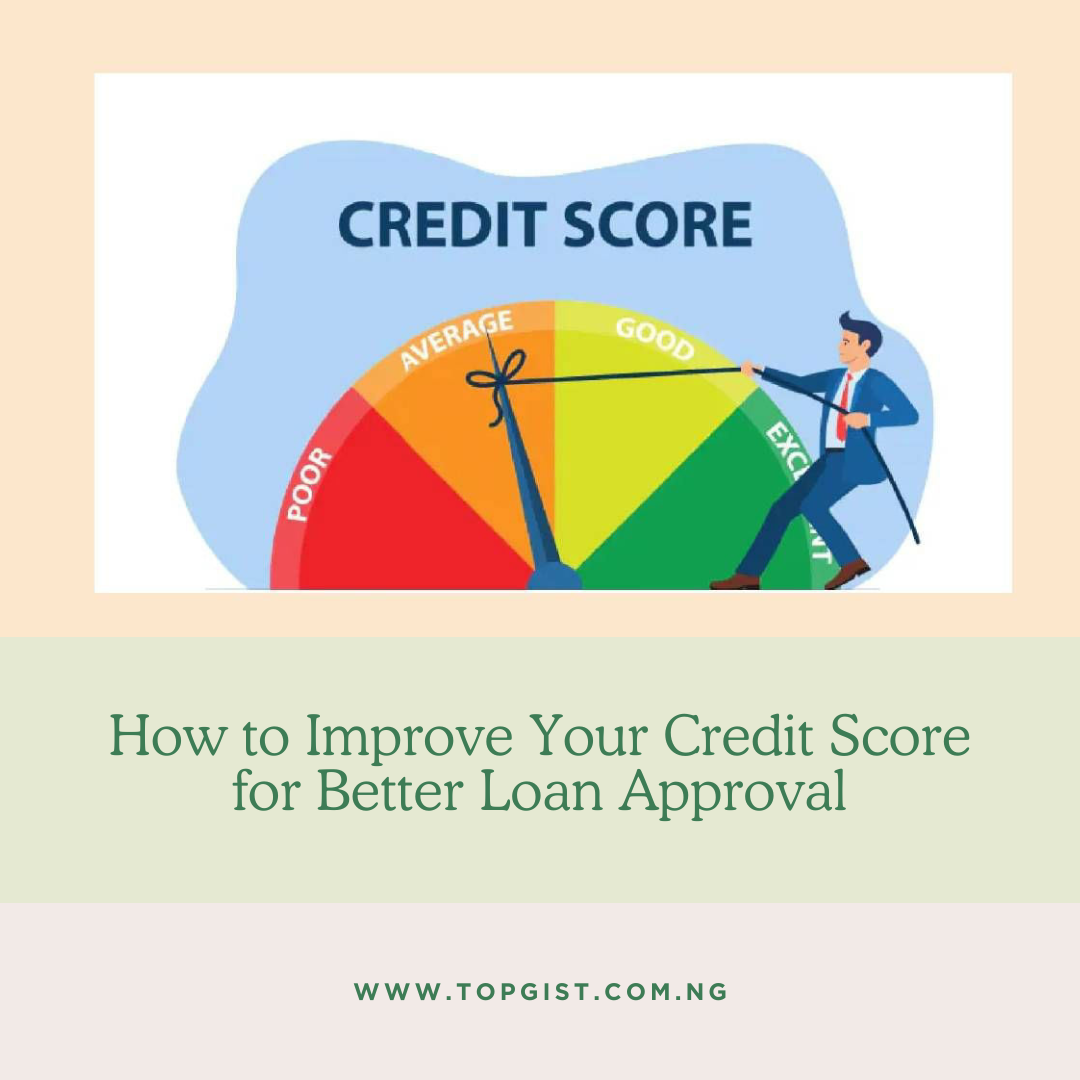
How to Improve Your Credit Score for Better Loan Approval
If you have ever applied for a loan and heard something like “your credit score is not strong enough,” it can feel confusing, especially when you know you earn money and you have been trying your best. In Nigeria, many people still think loan approval is mainly about your salary, your connections, or how persuasive you sound at the bank. But lending has changed. Banks, microfinance institutions, and many loan apps now depend heavily on data, especially repayment history and the overall pattern of how you handle credit. That is what a credit score tries to summarize.
The important thing to know is that a credit score is not a permanent label. It is more like a financial reputation that changes based on what you do consistently. If you pay late often, your score can drop. If you pay on time and reduce debt stress, your score can rise. If your report contains errors, your score can suffer until you dispute and correct those errors. When you understand this, you stop seeing credit score as something mysterious, and you start seeing it as something you can improve with practical steps.
This article is written in simple terms for Nigerians who want better loan approval results, whether you are a salary earner trying to qualify for a bank loan, a self-employed person trying to build credibility, or someone who has used loan apps in the past and now wants to clean up their profile. By the end, you will know what matters most, what to fix first, and what habits to keep so lenders can trust you.
What is credit scores and credit reports?
A credit report is a record of your borrowing and repayment history as reported by lenders and captured by credit bureaus. It typically shows the loans you have taken, credit cards or overdrafts (where applicable), the status of each facility, how you have paid over time, and whether you have any defaults, write-offs, or late payments. In Nigeria, credit reports may also include basic identity details used to match your record, such as name, phone number, and BVN-related data that supports accurate identification.
A credit score is a number generated from the information in your credit report. Think of it as a summary that helps lenders quickly estimate your risk. A stronger score usually suggests you pay on time, manage your credit well, and do not carry heavy unresolved debt. A weaker score often suggests missed payments, too many loans at once, frequent defaults, or a thin credit history where the lender cannot see enough information to trust you. This is why some people with “no debt” can still struggle to get loans, because the lender sees little or no credit history and cannot measure risk confidently.
The key takeaway is simple: your credit score improves when your credit report tells a healthier story. So the goal is not to chase the number blindly. The goal is to build a clean, consistent repayment history and fix anything that makes your report inaccurate or risky.
Why improving your credit score matters in Nigeria
In Nigeria, credit score improvement matters for two reasons that affect your life directly. First, it affects loan approval. A lender might reject you quickly if your profile looks risky, even if you have a job. Second, it affects the terms you receive when you are approved. Some borrowers get approved but with high interest rates, shorter tenors, or smaller loan limits, not because the lender hates them, but because the lender is pricing the risk. When your credit profile improves, you may qualify for better terms, larger limits, and less stressful repayment structures.
This matters even more today because many Nigerians have interacted with digital lending in one form or another. Some people borrowed from multiple apps during a difficult period, missed a few repayments, and then moved on. Later, when they want a bigger loan from a bank or a reputable lender, they are surprised that their past digital borrowing still follows them. Credit history is designed to remember patterns. That is the whole point. So if your past includes late payments, it can affect your present until you correct it with consistent good behaviour.
It also matters because a strong credit profile gives you options. When you have options, you can compare and choose the loan that makes sense. When your credit profile is weak, you are forced into desperate borrowing, and desperate borrowing is where high-cost loans and repeated rollovers often start.
How credit score and loan approval works in Nigeria
Most lenders in Nigeria combine three big things when deciding whether to approve your loan. The first is identity and verification: are you who you say you are, and can the lender verify your details confidently. The second is ability to repay: do you have stable income or consistent cash inflows that can carry the repayment. The third is willingness and discipline to repay: do you have a history that suggests you take repayment seriously. Your credit score and credit report sit mainly in that third category, but they also influence how the lender interprets the first two.
For salary earners, banks often look at your salary inflows, how long you have received salary into that account, and whether you already have heavy deductions. But they still run credit checks because a salary does not automatically mean you repay well. For self-employed people, lenders look at bank statement patterns, business stability, and also credit history. For loan apps and fintech lenders, credit scoring is often automated and heavily influenced by repayment behaviour across the system. This is why missing one repayment can affect more than one platform.
Another important point is that Nigerian lenders do not only look at “default or not.” They also look at your overall debt burden. If you have multiple loans at once, even if you are paying, your profile may look stressed. Stress is risk. Risk reduces approval chances and increases cost.
In-depth breakdown: how to improve your credit score step-by-step
Improving your credit score is not about one big action. It is about a series of small actions done consistently, in the right order. If you follow these steps, you will not only improve your score, you will improve the way lenders see your overall financial stability.
Check your credit report first before you try to “improve” anything
The first step is always to see what lenders are seeing. Many Nigerians try to improve their credit score without even knowing what is inside their credit report. That is like trying to treat an illness without diagnosis. You might be paying loans on time now, but your report might still show an old default you forgot about, a loan you never took, or a facility that was closed but still appears open. Until you check, you are guessing.
You can request your credit report from Nigeria’s credit bureaus. Two widely known bureaus where consumers can request reports and scores through their official platforms include CRC Credit Bureau and FirstCentral Credit Bureau. These platforms typically provide self-enquiry tools, credit score options, and dispute channels if you see errors. Keep your report safe, read it carefully, and focus on the sections that show overdue amounts, defaults, and the status of each credit facility.
A few official starting points (keep links minimal and use only when you are ready):
- CRC Credit Bureau: https://www.crccreditbureau.com/
- FirstCentral Credit Bureau: https://firstcentralcreditbureau.com/
Fix errors on your credit report quickly and properly
Credit report errors are more common than people think, and they can keep your score low even when you are doing the right things now. Errors can happen when your details were matched incorrectly, when a lender reported something wrongly, or when a loan was settled but not updated properly. If you see an error, do not ignore it. Raise a dispute through the credit bureau’s official dispute process and also contact the lender that reported the data.
When disputing, be organized. Provide evidence such as repayment receipts, settlement letters, screenshots of payment confirmation, or communication showing that the loan was resolved. The goal is to make it easy for the bureau and lender to verify and correct the record. Once corrected, your credit profile can improve because the score is calculated from the report. Many people waste months doing “credit improvement tips” while an error continues to drag the score down.
Pay every repayment on time, even if it is a small loan
If there is one habit that improves credit score more reliably than any other, it is on-time payment. Late payments are a strong negative signal because they suggest poor repayment discipline. In Nigeria, this can happen easily when you borrow from apps with short tenors and you forget the due date, or when salary timing shifts and repayment deductions fail.
The fix is practical: set reminders, use calendar alerts, and treat repayments like rent. If you can, repay a few days early so you are not caught by network failures, bank transfer delays, or unexpected issues. If you are struggling, contact the lender before the due date to discuss restructuring options where possible. Silence is what turns a manageable issue into a damaging default.
Reduce your debt load gradually instead of stacking new loans
Many Nigerians damage their credit score by stacking loans. You borrow from one app to repay another, then borrow again next month to survive. This creates a pattern of high debt stress, and even when you keep paying, lenders can interpret it as risky. A cleaner approach is to reduce the number of active loans and stabilize your finances before taking new ones.
Start by listing all your debts: app loans, salary advances, cooperative loans, overdrafts, and informal obligations. Identify which ones have the highest penalties or the most damaging reporting status. Then prioritize repayment. If possible, consolidate into one structured repayment plan with a single lender at a more manageable term, but only if the consolidation truly reduces cost and stress. The goal is to move from chaos to control.
Avoid making too many loan applications within a short period
Every time you apply for multiple loans, you leave a trail of credit enquiries and you also create a profile of desperation. Some lenders interpret many enquiries as a sign that you are being rejected elsewhere or that you are urgently seeking credit because of financial strain. Even when that is not true, the pattern can still affect you.
The smarter approach is to shortlist one or two options and apply strategically. If you are working on your score, give yourself time between applications so your profile stabilizes. Credit improvement is not only about repayment, it is also about how you behave in the credit market.
Keep your accounts and identity details consistent across lenders
In Nigeria, identity matching matters. If your name format changes across platforms, your phone number changes frequently, or your address and KYC details are inconsistent, it can complicate reporting and matching. This can lead to fragmented credit files or reporting confusion.
Use one consistent legal name across your bank accounts, loan applications, and official identity. Keep your BVN-related details consistent. Maintain a stable phone number linked to your banking and lending activities. The simpler your identity trail is, the easier it is for credit bureaus and lenders to track your true behaviour accurately.
Build a positive credit history if your file is thin
Some people have low scores not because they defaulted, but because there is not enough information to score them strongly. If you are new to credit, the aim is to build a small, clean repayment history. This can be done through a small structured facility such as a salary-based loan from your bank (if you qualify) or a small regulated loan you can repay easily. The key is not the size of the loan; it is the quality of repayment.
If you decide to build credit this way, borrow only what you can repay comfortably and treat it like a credit-building exercise. One clean loan repaid on time is better than three loans repaid with stress.
Negotiate and restructure before you default
If you are struggling, do not wait until you default. Default is what damages your profile most because it signals breakdown. If you see that you cannot meet the due date, contact the lender and ask for options: extending the tenor, setting a new repayment plan, or agreeing on a settlement structure.
Some lenders may not be flexible, but many will prefer a structured repayment plan over a full default. Even when you cannot negotiate, you can still protect yourself by paying something and communicating. Silence and missed payments are what create the worst reporting outcomes.
Keep your bank account behaviour stable and predictable
Even though credit score is primarily built from credit data, lenders often combine it with bank statement behaviour. A clean, stable statement pattern can support your application and may influence how a lender interprets your risk. Try to maintain consistent inflows, avoid repeated failed deductions, and avoid using your account as a chaotic pass-through for unrelated transfers.
If you are self-employed, bank consistently and keep business and personal funds clearer. If you are a salary earner, keep your salary account stable and avoid heavy unexplained withdrawals immediately after salary drops. These habits do not “change your credit score” directly in every case, but they support loan approval outcomes and reduce lender fear.
Requirements or eligibility to build a strong credit profile
There is no special eligibility to improve your credit score, but you do need a few practical foundations. You need at least one verifiable identity trail, which usually means consistent BVN-linked banking activity. You need at least one credit relationship if you want to build a credit history, which can be a loan, an overdraft, or a credit product reported to credit bureaus. You also need consistency: stable contact details, stable repayment behaviour, and stable financial habits.
If you are trying to repair a damaged credit profile, you also need patience. Credit systems respond to patterns. One good month helps, but several good months tell a stronger story. The goal is to create a new pattern that overrides the old one.
Common mistakes Nigerians make that keep credit scores low
Many people assume their score will improve simply because they stopped borrowing. But if you have unresolved defaults, stopping borrowing does not automatically clean your report. Another common mistake is paying late repeatedly because the amounts are small. In credit scoring, “small” does not matter as much as “late.” A ₦15,000 late payment can harm your profile just like a larger one, because the signal is about discipline.
Another mistake is using too many loan apps at the same time. Some people download five apps, collect small loans, and then struggle to track repayment dates. This leads to accidental late payments and penalties. Another mistake is ignoring credit report errors. If your report is wrong, you can be doing everything right and still be punished. Finally, many Nigerians fail to plan for repayment before borrowing. They borrow first, then hope income will appear. Credit improvement requires the opposite: plan first, borrow second.
After understanding these mistakes, realistic examples make the lessons clearer.
Cost breakdown: what improving your credit score can cost
Improving your credit score is not mainly expensive; it is mainly disciplined. But there can be some costs depending on your situation. The first possible cost is obtaining your credit report or detailed credit information, depending on the bureau and the report type. For example, some consumer report requests on bureau platforms may have stated prices, while some tools or promotional offers may allow free score access in certain conditions. Always use official channels and read the pricing clearly before paying.
The second cost is repayment itself. If your score is low because you have overdue loans, the real cost is settling them. Sometimes you may negotiate a settlement or repayment plan, but you still must pay something. The third cost is the “opportunity cost” of not borrowing for a while while you stabilize. Many Nigerians see this as a cost because they want money immediately, but a short pause can protect you from long-term debt traps.
The fourth potential cost is building credit if you have a thin file. If you choose to take a small loan or credit product to build history, the interest you pay is a cost, but it can be a controlled cost if the amount is small and the repayment is smooth. The key is that credit-building should not destroy your finances. It should be gentle and consistent.
Processing timeline: how long it takes to improve your credit score
Credit score improvement has different timelines depending on what is wrong. If the main problem is an error, your timeline can be relatively short once the dispute is resolved and the report is updated. If the main problem is overdue loans, improvement often begins after you settle or restructure and then maintain consistent on-time payment behaviour.
In practical terms, you may start seeing improvement within 30 to 90 days after correcting major issues, but stronger improvement usually takes several months of consistent behaviour. A healthy credit profile is not built in one week, because credit scoring systems look for patterns. If you are rebuilding after defaults, give yourself six to twelve months of disciplined repayment and reduced debt stress to create a stronger story.
The most helpful mindset is this: do not chase perfection. Chase consistent progress. If you can maintain on-time payment, reduce debt, and avoid new credit chaos, your profile improves over time.
Advantages and disadvantages of focusing on credit score improvement
The advantage of improving your credit score is obvious: you increase your chance of getting approved for loans, and you may qualify for better terms. You also gain financial confidence because you are no longer borrowing blindly. A stronger credit profile can reduce stress, open doors to structured finance, and help you plan larger life steps such as rent, school fees planning, or even future property plans.
The disadvantage is that it requires patience and discipline, especially if you are used to quick borrowing. Some people become frustrated because they want immediate results. Another disadvantage is that some credit score improvement advice online is unrealistic or copied from other countries without adapting to Nigerian realities. In Nigeria, the best approach is practical: correct your report, repay on time, reduce debt stress, and maintain stable identity and banking behaviour.
If you approach it with calm consistency, the advantages are far stronger than the disadvantages.
Better or alternative options if you need a loan now
Sometimes you need money urgently, and you cannot wait months for a score to improve. In that case, the goal is to borrow in a way that solves the problem without destroying your profile further. If you are a salary earner, a structured salary advance from your bank may be safer than stacking multiple app loans, because repayment is clearer and the lender may offer more predictable terms. If you are self-employed, a cooperative loan or a supplier credit arrangement can sometimes be safer than high-cost digital loans, depending on your situation.
Another alternative is to reduce the borrowing amount. Many Nigerians worsen their credit by borrowing more than necessary, then missing repayments. Borrowing less can keep repayment manageable and protect your profile. You can also explore payment plans with service providers, negotiate school fees payment schedules where possible, or combine small savings with a smaller loan.
These alternatives are not always comfortable, but they can protect your long-term credit profile while you handle the immediate need.
Consider This If You Must Improve Your Credit Score
If you want to improve your credit score for better loan approval in Nigeria, use this checklist. It summarizes what matters most, in the order that usually works best.
First, remember that the goal is not only a higher score, but a healthier credit story that lenders can trust.
- Get your credit report and understand what is inside before making new loan applications.
- Dispute and correct errors immediately with evidence.
- Settle or restructure overdue loans and stop defaults from growing.
- Pay every repayment on time, even small loans, and repay early when you can.
- Reduce loan stacking by decreasing the number of active loans.
- Avoid multiple loan applications in a short period.
- Keep identity details consistent across banks and lenders.
- Build credit gently if your file is thin, using small facilities you can repay comfortably.
- Maintain stable bank account behaviour and predictable inflow patterns.
Conclusion
Improving your credit score in Nigeria is not about tricks. It is about clarity, correction, and consistency. Start by checking your credit report so you know what lenders are seeing, then fix errors, settle overdue loans, and build a clean on-time payment pattern. Reduce debt stress by avoiding loan stacking and by borrowing only what you can repay without strain. Keep your identity and banking behaviour consistent so your credit file is accurate and easy to verify.
When you do these things, your credit profile becomes stronger over time, and stronger profiles get better loan approval outcomes. The process requires patience, but the reward is real: more options, better terms, and less financial stress.
FAQs (15)
1) What is a credit score in Nigeria?
A credit score is a number generated from your credit report that helps lenders estimate your repayment risk. It reflects patterns like on-time payments, defaults, and overall debt burden.
2) How do I check my credit score in Nigeria?
You can request your credit report and score through official credit bureau channels. Use recognized bureau platforms and follow their self-enquiry process.
3) How fast can I improve my credit score?
If the issue is an error, improvement can happen after correction. For repayment behaviour issues, improvement often starts within 30–90 days but stronger results usually take several months of consistency.
4) Does paying off a loan increase my credit score?
Paying off loans responsibly helps your credit profile, especially when it shows on-time repayments and reduced debt stress. But the impact depends on your overall history.
5) Can I have a low credit score even if I have never borrowed?
Yes. A thin credit file can make lenders cautious because they cannot see repayment behaviour. Building a small, clean credit history can help.
6) What damages credit scores the most?
Late payments, defaults, unresolved overdue loans, and heavy loan stacking are major factors that can keep scores low.
7) Do loan apps affect my credit score in Nigeria?
Many digital lenders report credit behaviour, and missed repayments can negatively affect your profile. Treat app loans seriously and repay on time.
8) If I settle a default, will my credit score improve?
It can improve over time, especially when the report updates to show resolution and you build new on-time payment history.
9) What should I do if my credit report has wrong information?
Raise a dispute through the credit bureau’s official process and contact the lender that reported the data, providing evidence such as receipts or settlement letters.
10) Does having many loans automatically mean a bad credit score?
Not automatically, but many active loans can signal high debt stress. Even if you pay, lenders may see higher risk if obligations are heavy.
11) Should I apply to multiple lenders to increase my chances?
It is usually better to apply strategically. Many applications can create multiple enquiries and make you look financially stressed.
12) How can salary earners improve credit scores faster?
Maintain consistent salary inflows, avoid missed deductions, repay on time, reduce debt burden, and keep a stable credit pattern over several months.
13) How can self-employed Nigerians improve credit scores?
Bank consistently, keep records, avoid loan stacking, repay on time, and start with small manageable credit facilities to build history.
14) Does changing phone numbers affect my credit profile?
Frequent changes can complicate identity matching and verification. Keeping stable contact details helps your credit record remain consistent.
15) What is the safest way to use credit while improving my score?
Borrow small, repay on time, avoid rollovers, track due dates, and keep your debt load comfortable so repayment never depends on hope.
About the Author